BA (Hons) Early Childhood Education and Care degree and Norland diploma
Why choose Norland
Combine your early childhood studies degree with the prestigious Norland diploma and industry-leading early years training
Overview of our Norland Early Childhood Education and Care degree
- As a national centre of excellence, our gold-standard training blends academic theory with practice to ensure you graduate fully qualified with extensive early years knowledge, practical skills and a wealth of hands-on experience.
- You’ll study our academic BA (Hons) degree alongside the practical Norland diploma, giving you both university-level knowledge and the highest level of early years training.
- Over a third of your time will be spent gaining practical experience on placement (1,265 hours) in a minimum of eight different early years settings and a 25-hour newborn experience.
- On completion of the early childhood degree and placements, you’ll gain industry-recognised Early Childhood Graduate Practitioner Competencies (ECGPC) status in both early childhood academic knowledge and practice skills.
- In your fourth year, you’ll spend 12 months as a probationary nanny in paid full-time employment that we find for you in order to complete the Norland diploma and earn the prestigious professional title Norlander/Norland Nanny.
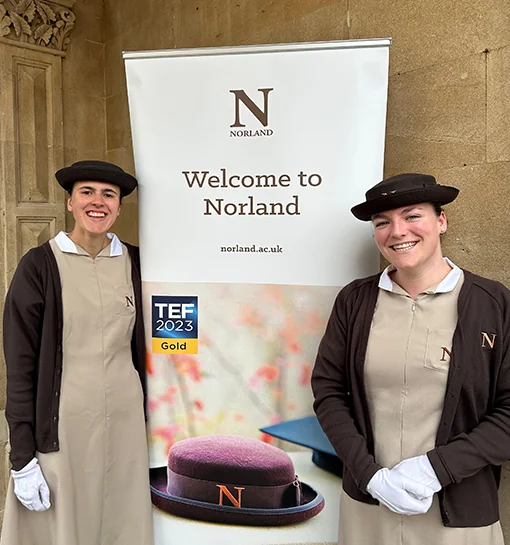
- You’ll receive employability focused training. We are Gold-rated for our outstanding student outcomes (TEF 2023) and were named the top UK university for graduate outcomes (Whatuni, 2021) in recognition of our focus on graduate employment.
- As a fully qualified graduate Norland Nanny, you’ll have access to our dedicated employment agency, your pick of jobs, above average graduate salaries and lifelong continuing professional development (CPD) opportunities.

Key course information
Duration
3 years full-time
Plus 1 year in full-time salaried employment as a Newly Qualified Nanny to complete the Norland diploma
Start date
September 2026
Qualifications
BA (Hons) Early Childhood Education and Care and Norland diploma
Course level
Undergraduate
UCAS institution code
N52
UCAS course code
X310
Tuition fees
£17,884 (2026/27) — UK students
£21,014 (2026/27) — International (Student visa) students
What you'll study
On our bachelor’s degree in Early Childhood Education and Care, you’ll explore child development, early learning, psychology, safeguarding and inclusive practice. You’ll combine academic study with practical early years training, preparing you to work confidently with babies, children and families.
Watch our Vice Principal and Head of Learning, Teaching and Research explain what you’ll study on our degree and the integrated Norland diploma.
A three-year Early Childhood Education and Care degree with integrated practical training
Our lecturers have a passion for this subject area and considerable professional and academic experience in education and working with families. Their teaching draws on many disciplines including psychology, neuroscience, child health, philosophy, social sciences and education. Guest speakers are regularly invited to Norland to give you an opportunity to listen to experts already working in the field.
National industry-recognised Early Childhood Graduate Practitioner Competencies (ECGPC) are integrated throughout the degree and placements. On completion, you will be a recognised Early Childhood Graduate Practitioner in both early childhood academic knowledge and practice skills, further enhancing your employability and career progression.
Running alongside our degree and for a fourth year following completion of the degree is the prestigious Norland diploma. This qualification will prepare you for all the practical aspects of the care and development of young children as well as critical professional and life skills.
The final module of the diploma is the Newly Qualified Nanny (NQN) year, a 12-month probationary nanny post in paid full-time employment that we find for you and support you throughout. No tuition fees are payable for this final fourth year in employment.
Learn more about the modules you'll study
How the Early Childhood Education and Care degree is structured
Each of the three years is divided into three trimesters with your time split between campus-based training and placements. You will spend around 35% of your time (34 weeks) gaining hands-on experience in a wide range of settings – a minimum of eight placements over the three years. You’ll complete placements in:
- family homes
- nurseries
- primary schools
- special educational needs settings
- hospitals.
These placements form a core part of your early years practical training and prepare you for the responsibilities of becoming a Norland Nanny.
In the third and final year of the degree, you will also be required to complete a work-based project on an early years topic of your choice. During the summer trimester of the third year, we focus on teaching you skills which will be relevant to your future employment. Among others, this includes first aid training, baby massage, employment contract advice, interview techniques, driving in arduous conditions and security training delivered by former military intelligence officers.
There are a number of different assessment methods for the degree and diploma courses at Norland. These include essays, presentations, vivas, portfolios, displays and a work-based project.
Find out how you will learn
It's all well and good doing the practice and it's all well and good having the knowledge and knowing the theory, but the real magic comes when you put those two things together. That's what Norland gives you... When you bring those two things together, that's when you get something really special.Lucy, Norland Nanny Watch Lucy's story
Degree and diploma programme specifications
These documents outline the full academic structure of the Early Childhood BA and the integrated Norland diploma.
Programme specifications
BA (Hons) Early Childhood Education and Care programme specification
View the full programme specification for our BA (Hons) Early Childhood Education and Care degree.
View BA (Hons) degree programme specificationNorland diploma programme specification
View the complete programme specification for the Norland diploma.
View diploma programme specificationDegree and diploma course map
See an overview of how the degree and diploma modules are structured across the four years.
View degree and diploma course mapWhy Norland's early years training stands out
Comprehensive early years training
Develop strong theoretical knowledge and practical early years skills through small class sizes, personalised support and specialist teaching.
View teaching methodsA supportive and close-knit learning environment
Experience a welcoming, nurturing community in Bath with outstanding student support designed to help you thrive academically and personally.
View supportExtensive placement experience in early years settings
Gain real-world experience in nurseries, schools, hospitals and family homes to build confidence working with babies and young children.
View placements100% guaranteed employment opportunities
As a Norlander, you’ll benefit from guaranteed employment opportunities and lifelong career support through the Norland Agency.
View career pathwaysSome of our students share their Norland stories


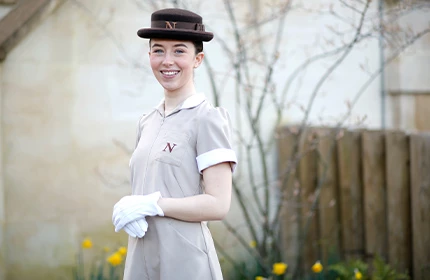
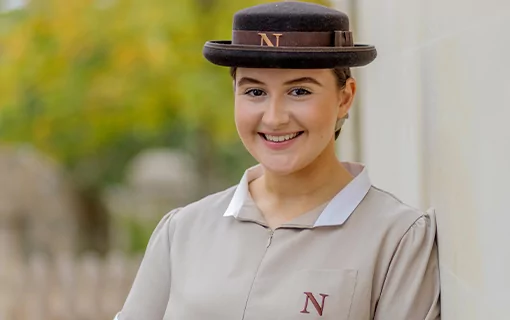
“I had a really amazing childhood and I wanted to give that experience back to other children and families.” – Harriet’s story
Read full story

“If you are passionate about working with children, there is no better place to study than Norland” – Hannah’s story
Read full story
“I found out that nannying was a career and that I could be in a family home and I liked the ability to make closer relationships with individual children.” – Sophia’s story
Read full story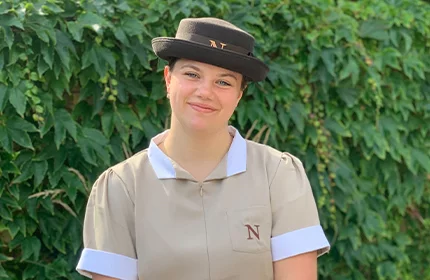
"Norland has the best support for students in my opinion from every institution I've experienced."
Read full story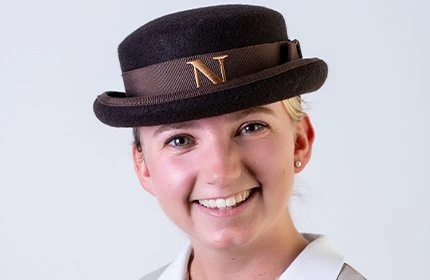
“Norland doesn’t just make you a nanny, it makes you an amazing early years practitioner.”
Read full story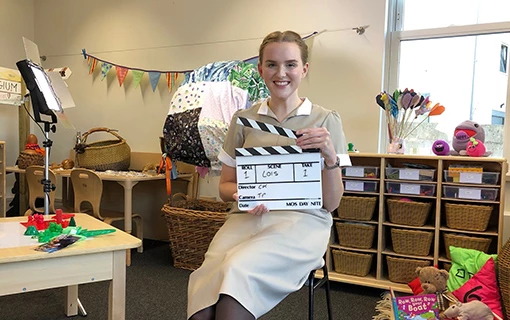
"I love what I do because I get to work with so many children. I get to make such a positive contribution to their lives."
Read full storyOur upcoming open events


Register your interest in studying at Norland to stay connected
Sign up to our mailing list to receive the latest study news and information about our open days, funding opportunities and student life.
Frequently asked questions
An early childhood studies degree explores child development, early learning, psychology, safeguarding and inclusive practice. At Norland, this academic study is combined with the skills-based Norland diploma, giving you specialist early years training and practical experience working with babies and young children.
Graduates typically progress into teaching, early childhood education, child development, children’s services and other early years roles. At Norland, completing our degree and integrated Norland diploma also leads to 100% guaranteed employment as a Norland Nanny through the Norland Agency.
Norland is the only institution where you can study a BA (Hons) Early Childhood Education and Care degree alongside the Norland diploma. This dual qualification combines academic study, specialist early years skills training, extensive placements and lifelong career support when fully qualified. The Norland diploma is unique to Norland and is the only place where you can study this early years qualification.
Yes. You will complete a minimum of eight early years placements across nurseries, schools, hospitals and family homes. These placements are part of the academic degree but also allow students to apply the practical skills taught on the Norland diploma.
The Norland diploma is studied alongside our BA (Hons) degree. While our degree provides academic knowledge in child development and early years education, the diploma focuses on practical skills, food and nutrition, sewing and professional preparation for working with children and families.
Norland offers a full-time BA (Hons) Early Childhood Education and Care degree, studied alongside the Norland diploma. Together, these form a complete academic and practical childcare training programme. Norland does not currently offer short childcare courses or separate vocational programmes.
No. Norland does not currently offer online nursery-nurse or distance-learning courses. Training is delivered in person on campus in Bath and includes placements, practical skills development and classroom-based teaching.
Our BA (Hons) Early Childhood Education and Care degree will:
- Equip students with the necessary professional leadership, management and practical skills to work in a variety of early childhood contexts, with a specialism in home-based childcare.
- Facilitate the application of in-depth and current knowledge to allow students to work effectively, confidently and ethically in a child-centred way with babies and young children; drawing on the latest multidisciplinary research and contemporary practice.
- Instil in students a respect for – and an appreciation of – the importance of diversity inclusion, society and culture in relation to the growth and development of babies and young children.
- Facilitate the application of theoretical knowledge to real world experiences; providing high quality early childhood education and care for babies and young children and support for their families, with an ethos of mutual respect and understanding, and a loving pedagogy.
- Support students to become reflective practitioners with a critical understanding of the diverse worlds of babies and young children, and an awareness of how early childhood experiences shape their lives.
- Support students to reflect critically and develop their own education and childcare pedagogies, theory and leadership capacities, by engaging with debate and discourse with reference to multidisciplinary research, legislation, policy and international perspectives.
- Equip students with the skills to manage the wellbeing of both themselves and the babies and young children in their care, and the tools to support young children to co and self-regulate across the many transitions which babies, children and their families experience.
- Equip students with an awareness of sustainability and ecological practices in early childhood and education contexts, both for themselves and the babies, young children and families with whom they work.
The Norland diploma will:
- Support students to work safely and skilfully in a variety of early years environments, including home-based education and care.
- Support students to engage fully with the Code of Professional Responsibilities and demonstrate the attributes required to uphold the professionalism expected of a Norland Nanny.
- Equip students with the practical skills to work effectively and confidently with babies, infants and children aged 0–8 and their families, with a specialism in 0-to-36-month-olds.
- Support students to provide high-quality education and care for babies, infants, children and their families with an ethos of mutual respect, adaptability, understanding and professional love.
- Equip students with a respect and appreciation of different early childhood experiences and the way these can shape the lives of babies, infants and children.
- Support students to successfully regulate their own wellbeing as a professional practitioner.
- Provide students with the skills to support the babies, infants, children and families with whom they interact to co- and self-regulate across the many transitions they experience.
- View the course programme specifications via the links above to see the learning outcomes for the degree and diploma.
Norland is registered as a taught degree awarding provider with the Office for Students, the regulator for higher education in England:
The Norland BA (Hons) in Early Childhood Education and Care is a full Level 6 degree award that is mapped to the QAA subject benchmark statement for Early Childhood Studies and includes the required element of assessed practice in an early years setting. It meets all the requirements of a ‘full and relevant’ early years qualification by the Department for Education for counting in the Early Years Foundation Stage statutory framework staff:child ratios.
The Norland BA (Hons) in Early Childhood Education and Care degree meets all the criteria for early childhood degrees with Early Childhood Graduate Practitioner Competencies (ECGPC) awarded at Level 6. These are assessed practice competencies that evidence the student’s holistic understanding of early childhood development and their ability to apply, critically evaluate and communicate theoretical knowledge to practice. Norland can award the title Early Childhood Graduate Practitioner to students who successfully meet all the competencies. The Early Childhood Studies Degree Network (ECSDN) approves and monitors the application of the framework.