Transitioning to Norland: A Level students
16 March 2026
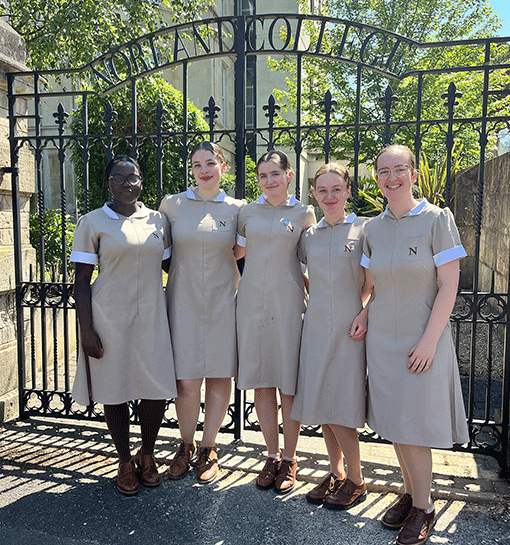
Students come to Norland from a wide range of educational backgrounds and subjects studied – from English Language and Photography to Maths and Physics. In this interview, first-year students Mia and Leah (Set 149) and second-year students Carolina and Verity (Set 148) share their experiences of moving from A-Level study to Norland’s BA (Hons) Early Childhood Education and Care degree and diploma.
Please briefly introduce yourself
Mia, first-year student, Set 149: “My name is Mia and I’m in Set 149 at Norland, which means I’m currently in my first year. I’m from Horley in Surrey, about 3 hours away from Bath. Before coming to Norland, I studied A Levels in Drama & Theatre Studies, English Language and Geography.”
Leah, first-year student, Set 149: “My name is Leah Davies, I am also in Set 149, I’m currently staying in the Channel Islands, but I grew up in South Africa and England. Before starting at Norland, I studied 3 A Levels and an AS. My subjects were English Language, Mathematics and Physics, as well as Afrikaans as my AS Level.”
Carolina, second-year student, Set 148: “My name is Carolina and I’m in Set 148, in my second year. I have always adored working with children and I feel incredibly grateful to be studying something I’m so passionate about. Before joining Norland, I studied A Levels in Psychology, Sociology and Biology.”
Verity, second-year student, Set 148: “My name is Verity and I’m in my second year as well, part of Set 148. I grew up in Essex where I completed my A Levels in Media, Drama and Photography. I also took a gap year where I worked in hospitality and volunteering in a nursery before applying to Norland.”
How did A levels, and the subjects you studied, help you prepare for your Norland studies?
Mia: “When I chose my A Levels, I had no idea how much they would help me when studying at Norland. Drama was amazing for building my confidence and creativity. I also got used to speaking in front of people and thinking on my feet, which is very helpful when you’re working with children since they can be unpredictable! My English Language course included a module on child language acquisition which gave me a deeper understanding of how children communicate, learn to talk and express themselves which directly relates to what we learn at Norland. Plus, it improved my writing skills for the essays we have for assessments.
“At first, studying Geography might seem unrelated, but it really opened my eyes to the world around me and how it is full of different cultures and environments. This curiosity and appreciation for the world is something I bring to my work with children now. I also did an Extended Project Qualification, which was great for building my research and organisational skills. Plus, it taught me how to manage my time and work independently, which is useful at Norland. Looking back, all of these subjects helped me in different ways and made me feel much more ready to take on the course.”
“My A levels were a solid foundation in building the academic skills I’ve used at Norland so far”
Leah: “I would say that from the subjects I studied, English Language prepared me the most for my studies at Norland. One particular topic we studied was child language development, which I really enjoyed, and also directly applies to what we learn at Norland.
“Studying both Maths and Physics taught me problem-solving skills and resilience that I have put into practice. Overall, my A levels were a solid foundation in building the academic skills I’ve used at Norland so far. For example, one of our first assignments was to write an essay, which I felt confident to do as I’ve written many for English Language over the last two years. I also developed research skills through both English and Physics, which I have built on since my A levels and used in my studies at Norland so far.”
When I chose my A levels, I had no idea how much they would help me when studying at Norland.Mia
“There are many transferable skills that I use now in my studies at Norland.”
Carolina: “Although they’re not directly linked to childcare, from the A levels I studied, there are many transferable skills that I use now in my studies at Norland. Studying Psychology, I learned about different research methods which I now use when completing my assignments.
“Additionally, both Biology and Psychology A levels helped me develop an understanding of neuroscience, which has been really valuable in applying to what we learn about child development in our degree. From Sociology, I’ve carried forward my skills in essay writing and critical thinking. These have continued to grow and improve throughout my first year and now into my second year at Norland.”
“The creative sides of these subjects have allowed me to embrace my own creativity”
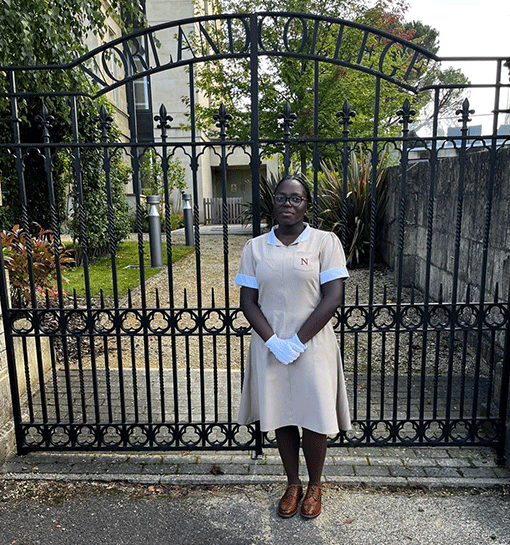
Verity: “Personally, I found A-levels a great way to prepare me for more specialised learning topics. All my A-levels were coursework based which I found prepared me for Norland. For example, coming into Norland with experiences of vivas from Drama, as well as presentations and essays from studying Media, meant that the range of coursework we do in Norland was familiar to me and I had no issues with the structuring of assignments.
“As well as this, the creative sides of these subjects have allowed me to embrace my own creativity when working with children on our placements, designing activities with them. Also, through my knowledge of a range of drama and photography techniques, I have been able to adapt these into childcare activities with confidence. I am also used to the more ‘hands-on’ approach to learning which is called for in our diploma subjects such as Food and Nutrition and Sewing.”
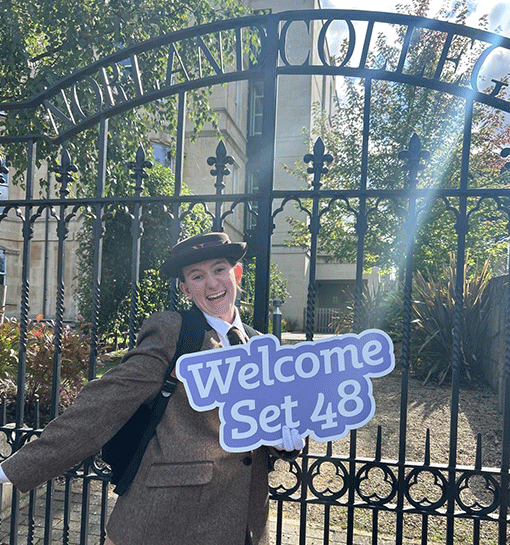
The experiences of Carolina, Verity, Mia and Leah show that success at Norland isn’t defined by the subjects you studied at school, but by the skills, curiosity and commitment you bring with you. Whether your A-Levels were in English Language or Photography, Maths or Physics – or anywhere in between – what matters most is your willingness to learn, grow and embrace the rigor and reward of Norland training. With the right mindset, every student can thrive on the journey to becoming an outstanding early years professional.
Learn more about applying to Norland