From sibling support to music: students share their research topics
16 April 2026
In the third year of their Early Childhood degree, Norland students undertake an in-depth research project focused on an area of the early years that matters most to them.
The Work Based Project gives students the opportunity to personalise their studies, drawing together the knowledge, skills and professional experience they have developed throughout their three years of study and practice.
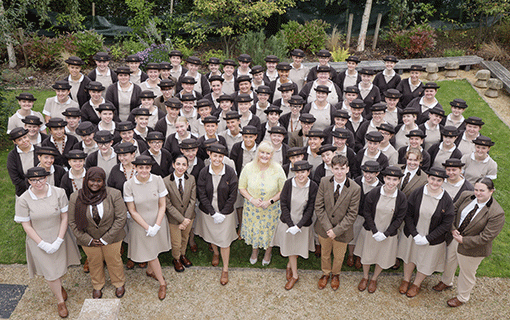
This year, Set 147 students have chosen to research a wide range of topics from sibling support in language development to children’s responses to music.
We spoke to third-year students, asking them to share the title of their project and why they chose to research it.
Taylor-Jae: What are parents’ motivations for choosing home education in the early years?
“My project explores parents’ motivations for choosing home education in the early years. I want to understand why some families choose home education rather than traditional early years settings and what factors influence this decision.
“I chose this topic because I was home educated myself, which sparked my interest in exploring parents’ perspectives and experiences. With home education becoming increasingly common, I am interested in gaining a deeper understanding of the motivations and values that lead families to make this choice in the early years.”
Grace: The importance of outdoor education and play for young children
“I grew up in the countryside and loved outdoor play, forest school and everything it involved. I now use this as a tool within my nannying practice and wanted to explore parents’ views on outdoor learning, as well as how these skills can be used and developed in an everyday, household setting.”
Chloe: A child’s perspective on autonomy
“I chose this topic as during my training I have been able to see what children can do alone and the decisions they make for themselves. I want to explore how this influences their daily life and development.
“I believe autonomy is an important concept and children should be given opportunities to make choices now, and in their future. Ensuring that their voice is heard and valued, in situations that concern them.”
Heather: What is home? A discussion of belonging from the perspectives of ‘Third Culture Kids’
“I grew up in a third cultural environment, with a total of six moves between countries before I was 14. I personally noticed a difficulty in connecting a specific location with the idea of ‘home’ after settling back in the UK.
“This experience motivated me to explore the perspectives of third culture children. Much of the existing research is based on the reflections of adults from a third culture background, and I believe it is vital to highlight the experiences of children currently living in third culture environments, to give these children a voice.”
Skye-Sophia: Supporting military children through transitions
“Transitions can be challenging for any child, but for military children, many of the transitions they experience are life-changing. These include frequent moves between schools, homes and countries, separation from friends and family, and parental deployment, all of which can have a huge impact on that child’s emotional wellbeing.
“As a military child myself, I have witnessed and experienced first-hand how significant it is to have the right support and strategies in place in an area that is often overlooked due to misunderstanding and lack of knowledge. Through my research, I hope to support early years professionals and parents to better understand military children’s experiences and how to support children to have the most positive outcomes.”
Kate: The different methods used to communicate within military families during overseas deployment
“My interest in this topic stems from family ties to the military, as well as a lack of existing research around military families that is not US-based.”
Lily: How older siblings support the language development of younger siblings
“I chose to focus my dissertation on language because communication sits at the heart of how children understand the world and connect with people around them. Language develops through everyday moments, often during simple, shared experiences. When children are encouraged to communicate, they are given the confidence and agency to express their needs, emotions and ideas.
“Sibling relationships offer a unique space for this, as siblings often communicate in ways that are child-led, playful and free from adult direction that allows younger children to practise using their voice in a safe and familiar relationship. By focusing on language within sibling interaction, I wanted to explore how these everyday moments help children develop confidence, understanding and a sense of power through communication.”
Lea: Exploring how gentle parenting is constructed on social media and how parents respond to these representations
“I chose this topic because I have personally seen how much social media can influence the way parents think about raising their children. ‘Gentle parenting’ is often presented online as the ideal current approach, and I was curious about how these narratives are created and how they impact parents. I’m passionate about supporting families in a realistic and balanced way in my practice, so understanding both the online narratives and real parents’ experiences on this topic felt important to me.”
Holly: Children’s responses to reggae music
“My father was a DJ, so music surrounded every aspect of my childhood, and I have always been fascinated by its power. In some cultures, reggae music is widely used with young children and is believed to have a calming effect.
“While research into music and children is vast, it primarily focuses on Western musical styles, such as classical music. I found no formal research into the claims that reggae can calm babies, even though it is considered common knowledge for those who use it. Therefore, I hope to bridge this gap in research to explore how children respond to reggae music.”
Phoebe: The value and role of emotional regulation strategies in supporting children’s development and wellbeing
“I chose this topic because I am fascinated by how emotional regulation underpins neurological functioning in all human beings, shaping social relationships, physical capabilities, intellectual development, as well as our relationship with ourselves.
“Early childhood is widely recognised as the most sensitive period for neurological development, and practitioners who support the development of emotional regulation in the early years play a vital role in contributing to a child’s long-term wellbeing. I believe this positive impact on wellbeing represents a central goal of early years practice, as well as my personal practice. In my dissertation, I review extensive theoretical and empirical literature alongside primary research to examine the purpose and value of emotional regulation strategies in best supporting children.”
Rachel: How practitioners support children in the transition from pre-school to reception
“I chose this topic as school readiness is something I often support children and families with in my role as a nanny. Through my research, I wanted to further my knowledge and create a rounded understanding of how I can best support families and children through this common transition.”